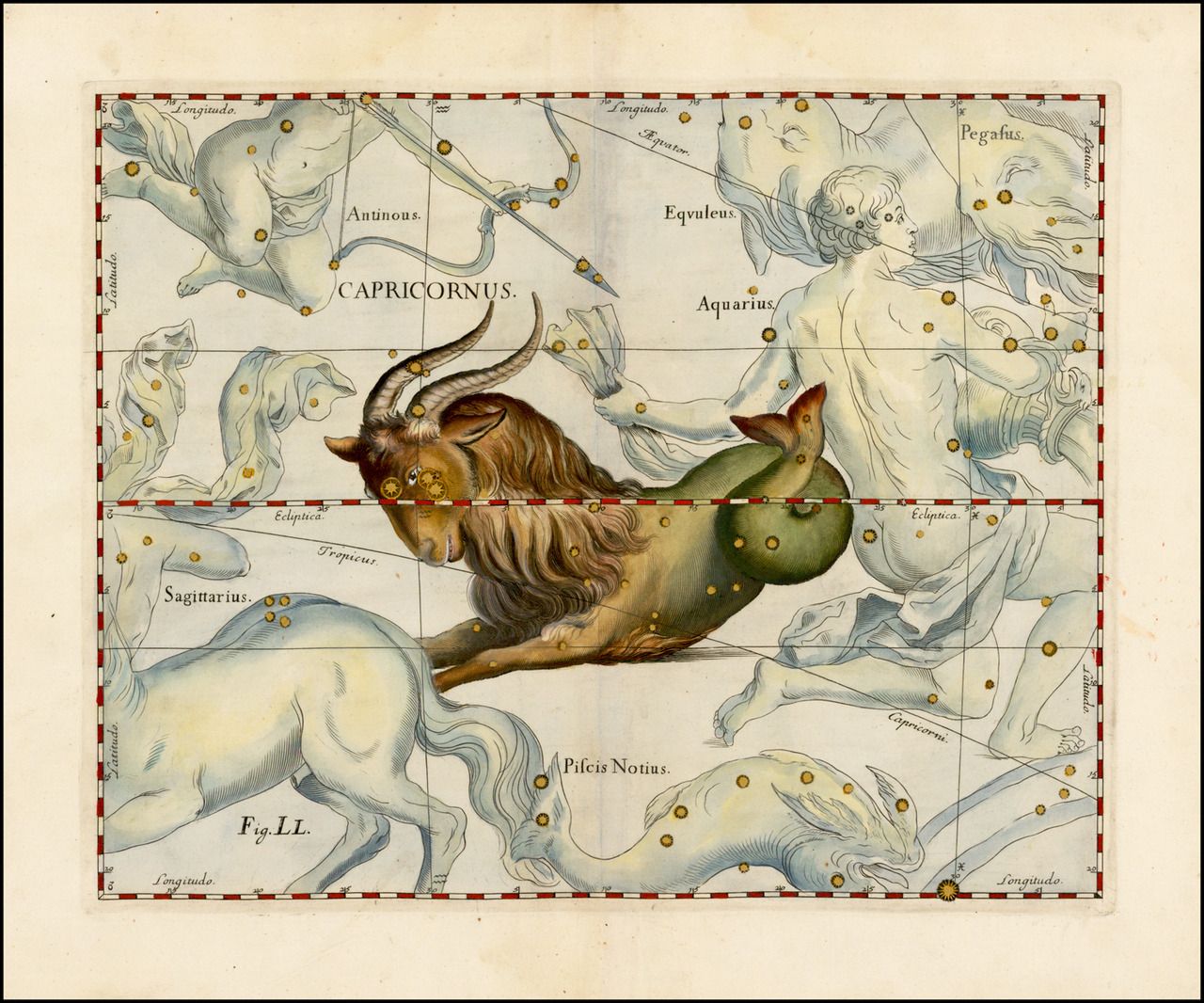
The Firmamentum Sobiescianum sive Uranographia, published posthumously in 1690, represents a pinnacle of the Golden Age of celestial cartography. Johannes Hevelius, often called the father of lunar topography, brought a unique blend of scientific precision and artistic flourish to this work.
What sets Hevelius apart from his contemporaries—like Bayer or Flamsteed—was his insistence on using the naked eye for his measurements, even as the telescope was becoming the standard. Despite this, his accuracy was legendary, and his atlas remains a bridge between the myth-heavy maps of antiquity and the data-driven charts of the modern era.
The Survivors: Hevelius’s Legacy:
Of the eleven constellations Hevelius introduced, seven survived the reorganization of the night sky by the International Astronomical Union (IAU) in 1922 and are still recognized today:
Scutum The Shield: Originally Scutum Sobiescianum, named to honor his patron, King John III Sobieski of Poland.
Canes Venatici The Hunting Dogs: Depicted as two dogs, Asterion and Chara, held on a leash by Bootes.
Leo Minor The Lesser Lion: Placed between the larger Leo and Ursa Major.
Lynx: Named not for its appearance, but because Hevelius claimed one needed the eyes of a lynx to see its faint stars.
Sextans The Sextant: A tribute to the astronomical instrument Hevelius used and lost
Lacerta The Lizard: A small, zigzagging constellation in the northern sky.
In the Firmamentum Sobiescianum 1690, Hevelius’s depiction of Capricornus is a masterclass in his technical work, blending classical mythology with the precise star positions.
There is a specific technical detail to correct in that perspective: In Hevelius’s Mirror-Image Perspective, because the plates were designed for celestial globes, viewing the stars from outside the sphere, the directions are flipped compared to a standard terrestrial map.
For Capricornus in the Uranographia:
On the page: The goat’s head actually points toward the right, which in this mirrored celestial coordinate system represents West.
In the actual sky: When you look up from Earth, the goat’s head points toward the left West from the perspective of an observer in the Northern Hemisphere looking south.
West is to the left, which is the opposite of how a standard modern star chart, viewed from Earth looking up would be oriented. This allowed globe makers to pull together the paper strips and paste them directly onto a sphere to create a correct external 3D model. The Celestial Sequence West to East:
Capricornus, The Sea-Goat: Marks the westernmost boundary of this group. In the Uranographia, its head is oriented toward the left margin.
Aquarius,The Water Bearer: Sits immediately to the East,the right-hand side of Capricornus on Hevelius’s plates.
Pisces, The Fishes: Occupies the massive expanse of space further to the East.
Technical Artistry in the Golden Age:
The Uranographia was famous for its mirror-image orientation. Hevelius engraved the plates to show the stars as they would appear on a celestial globe looking down from outside the heavens rather than how we see them from Earth. This required astronomers of the time to pull together their mental maps and flip the perspective to use it at the telescope.
nonpracticing is not nonhereticcapricornus – The Firmamentum Sobiescianum sive Uranographia of Johannes Hevelius 1690
- 1518&projects
- ai content generator
- air-cavitas-oris
- is not – continued since 9 september 2018
- 1518&projects, 1690, 1690 astrology, 50, air cavitas oris, astronomy, Canes Venatici, Capricornus, cavitas-oris, Celestial Atlas, celestial cartography, Celestial Navigation, Celestial Sphere, Cetus, Cetus the Whale, coelum stellatum, constellation Europe’s Golden Age, create, culture, DDO&V, design, Firmamentum Sobiescianum, first published - 8 august 2015, Golden Age of Cartography, IAU Constellations, it's more, J-40, Johannes Hevelius, King John III Sobieski, Lacerta, Leo Minor, Lynx, Mira Ceti, Mirror Orientation, morotonny, Mythological Constellations, Naked-Eye Astronomy, Scutum, Sea Monste, Sea-Goat, Sextans, star catalogue, Star Catalogues, Star Maps, The Firmamentum Sobiescianum sive Uranographia of Johannes Hevelius 1690, totum, Uranographia, Variable Stars, Vulpecula cum Anser, workshop