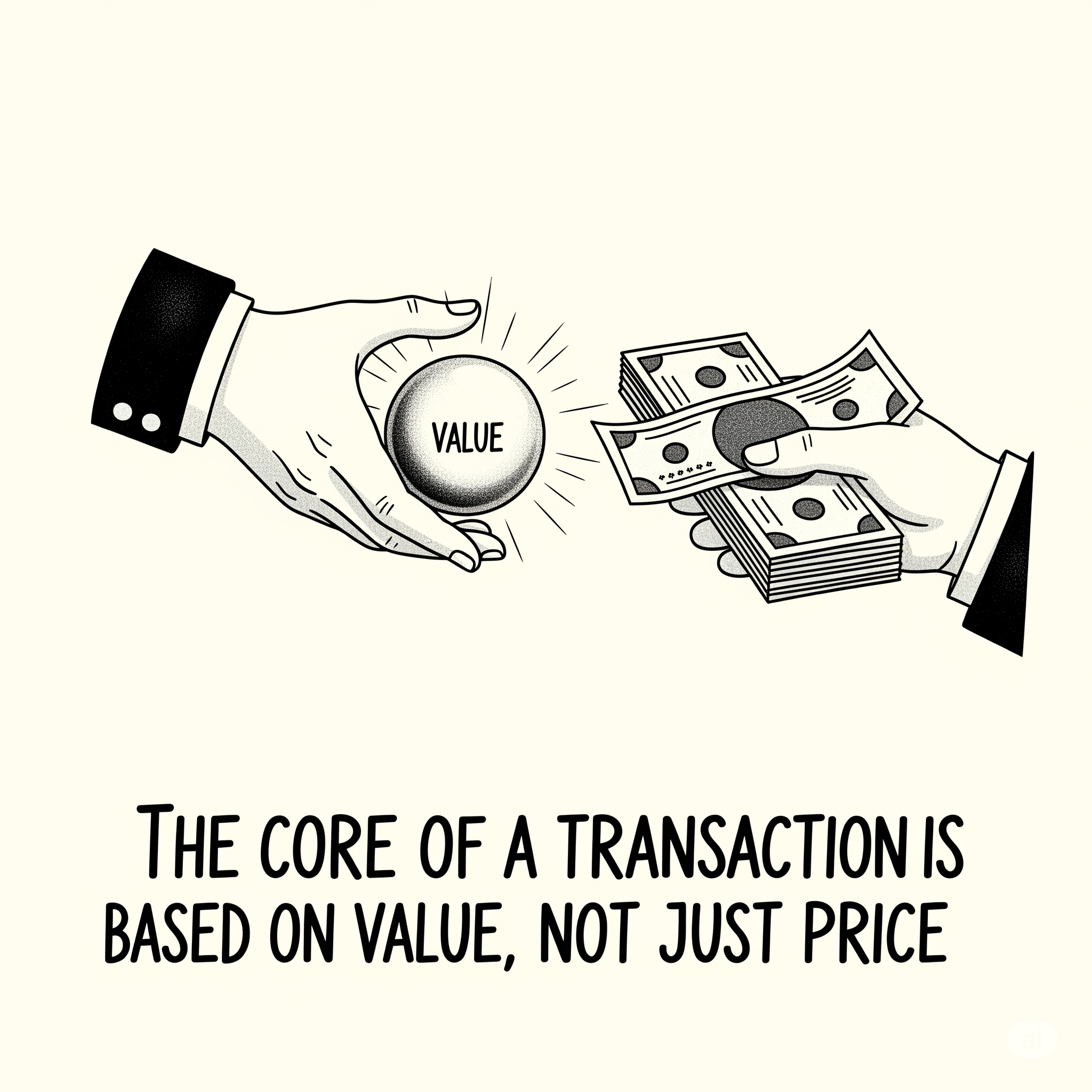
At its core, every commercial transaction is a simple exchange: the seller provides a product or service to sustain their business, and the buyer receives something of value to meet a need. Ideally, this is a win-win where both parties walk away with a profit.
However, this straightforward relationship often becomes strained or obscured. While the goal is a seamless trade, several factors—particularly the involvement of third parties—can make transactions significantly more difficult. Why Intermediaries Complicate the Exchange:
In a perfect world, a buyer and seller meet directly. In reality, a modern transaction often involves a long chain of third parties, including distributors, wholesalers, banks, and payment processors.
Diluted Value: Each intermediary takes a “slice” of the profit. This can drive the price up for the buyer while shrinking the actual revenue for the original seller.
Communication Gaps: When a third party sits between the two primary stakeholders, the “voice of the customer” can get lost. Misunderstandings regarding product specifications or delivery timelines often arise because the information is being filtered through multiple layers.
Information Asymmetry: Transactions become difficult when one party knows more than the other. If a seller hides a defect or a buyer is unaware of the fair market price, the trust required for a healthy exchange evaporates.
The “Middleman” Bottleneck: Third parties can introduce bureaucratic delays. For example, a payment system might hold funds for “security reasons,” or a logistics provider might misroute a shipment. In these cases, the intermediary is no longer a facilitator but a barrier to the transaction’s completion.
It is important to remember that profit is a functional necessity. Profit allows a seller to pay employees, innovate, and continue serving the buyer. To ensure this flow remains uninterrupted, legal frameworks such as those in the UK, US, and EU, exist to prevent third parties or competitors from unfairly disrupting trade. Laws regarding unfair competition, trade secret and late payments are designed to strip away the “noise” and return the focus to the primary goal: a fair, efficient exchange. Ultimately, we must not make the process more difficult than it needs to be. Transactions are protected by law because making business happen is essential for growth and stability.
Ownership vs. Possession
A critical part of any transaction is the transfer of Ownership. Ownership is a legally enforceable right that grants exclusive authority to possess, use, transfer, and exclude others from an asset.
To protect your assets against false claims, you must follow these steps:
Formalize with Documentation: Maintain deeds, titles, or bills of sale for physical property, and register intellectual property (IP) to provide the strongest legal defense.
Distinguish Possession from Title: Never equate “having” with “owning.” Someone holding your asset (like a borrower) has temporary control, but no legal title.
Enforce Your Right to Exclude: Use formal tools like notices to vacate or “cease and desist” letters to stop unauthorized use immediately.
The Legal Reality
Confusing physical possession with legal ownership is a dangerous misunderstanding of the law. It ignores the fundamental distinction between temporary control and a permanent, enforceable right. Relying on legal documentation and a clear understanding of property law is the only true defense against such claims
screw driver is not car driverbusiness transaction – conceived by 1518&projects and generated by gemini 2025
- 1518&projects
- ai content generator
- air-cavitas-oris
- is not – continued since 9 september 2018
- 50, air cavitas oris, anchoring bias., antitrust, B2B, B2C, behavioral economics, bottom-line growth, business ethics, business risk, business's net income, cavitas-oris, cognition, Cognitive Bias, Commercial transaction, Competition law, consumer behavior, consumer protection, consumer psychology, Copyrights, create, culture, DDO&V, decision-making, design, economic principles, emotional value, EU Directive., exchange, generic, information asymmetry, it's more, J-40, late payment, legal framework, loss aversion, make money, market dominance, market dynamics, net earnings, net income, net profit, nieruchawka, nieruchomosci, ownership, payment terms, profit maximization, psychology of money, purchasing., revenue generation, sales, sales team, social status, sunk cost fallacy, supply chain, the main role of sales is to make money, top-line growth, trade, trust, unfair practices, Uniform Commercial Code (UCC), value perception, workshop